
- What Is a Grounding Sheet?
- How The Sheets Work (Step by Step)
- Do They Work? My Real-World Testing
- More Testing & Evidence
- My Personal Experience
- What Does the Science Say About Grounding Sheets?
- Frequently Ask Questions (FAQ’s)
- How to Set Up a Grounding Sheet (With Photos)
- Final Thoughts: Are Grounding Sheets Worth It?
Most people don’t have the luxury of walking barefoot on grass every morning or lying in a field to “ground” themselves.
Sure, I would walk on the beach barefoot, go swimming in natural bodies of water every now and then. But I was living in an apartment, surrounded by concrete, spending more time under artificial light than in nature.
This is where I kept hearing about grounding sheets through social media channels like Tik Tok and Facebook.
Grounding sheets work on a simple principle: once you lie down, they keep you connected/grounded to the Earth’s energy for as long as you’re asleep (for me that’s 8+ hours), night after night.

On June 10th, 2023, I bought my first set on Amazon, curious if they could actually mimic the effects of being barefoot outdoors. Rather than just taking the claims at face value, I tested them myself… first with a multimeter, and then with over two full years of daily use.
In this article, I’ll share what grounding sheets really are, what science says about them, and the results of my own testing.
What Is a Grounding Sheet?
A grounding sheet, sometimes called an earthing sheet looks just like a regular bed sheet.
The main difference here is that grounding sheets are woven with conductive fibers (often silver or carbon) that allow electrons to flow.
The purpose isn’t to power anything, but to create a safe connection between your body and the Earth’s natural electrical field.

See, connecting to the Earth and nature with our bare skin may sound like a fairy tale, but it’s actually rooted in physics and biology. Our bodies are electrical systems: our hearts, brains, and cells all rely on electrical signals to function. When we make direct contact with the ground, whether by standing barefoot on grass or sleeping on a grounding sheet, our bodies equalize with the Earth’s natural charge.
How The Sheets Work (Step by Step)
- The Grounding Port in Your Outlet
- Modern buildings are wired with grounding systems. The small round hole in your wall outlet (beneath the two vertical prongs) connects directly to the Earth through grounding rods or wiring buried in the ground.
- The Grounding Cord
- A grounding sheet comes with a cord that plugs into this grounding port. The other end attaches to the sheet itself, creating a direct bridge between the Earth and the conductive fabric.
- Conductive Materials in the Sheet
- Inside the sheet, special threads, soften silver or carbon, are woven into the cotton or bamboo fabric. These threads conduct electricity and carry the Earth’s charge evenly across the sheet’s surface.
- Body Contact
- When your bare skin touches the sheet, your body shares the same electrical potential as the Earth. In other words, you are grounded for as long as you’re in contact with it.
Do They Work? My Real-World Testing
I didn’t want to just take marketing claims at face value. To see if grounding sheets actually worked, I ran my own tests with a multimeter and documented the results.
Voltage Drop Test with a Multimeter
The principle is simple: if the grounding sheet is working, your body’s voltage should drop when you’re lying on the sheet compared to when you’re not.
- Without the sheet – My body voltage measured ~1.45 volts AC (photo 2).
- With the grounding sheet – My body voltage dropped down to ~0.16 volts AC (photo 1).
That’s nearly a 10x reduction, showing that the sheet was successfully grounding me through the conductive fibers, grounding cord, and outlet ground port.


Photos of My Setup
To make this as transparent as possible, I photographed the process (as seen above). Here’s what’s going on:
- First Photo: A multimeter connected to my body without the grounding sheet.
- Second Photo: The same setup while lying on the sheet, with a visible drop in voltage.
Why This Matters
The multimeter test proves continuity: the sheet isn’t just fabric, it’s conducting and actually reducing body voltage when connected to ground. While this doesn’t “prove” health benefits on its own, it does confirm the sheet is doing what it’s designed to do — keeping the body grounded.
More Testing & Evidence
My Improvement in Heart Rate
Beyond voltage-drop tests, I also tracked my resting heart rate (RHR) over time while consistently using grounding sheets. Resting heart rate is a key biomarker of cardiovascular health, recovery, and stress levels—the lower and more stable it is, the better.
- In 2023, my average resting heart rate was 61 bpm.
- By the following year, after using grounding sheets regularly, my average dropped to 56 bpm—a decrease of about 5 beats per minute.
This change isn’t just a random fluctuation. A lower resting heart rate generally reflects reduced stress on the cardiovascular system, improved recovery, and better autonomic balance between the sympathetic (“fight or flight”) and parasympathetic (“rest and digest”) nervous systems.


Backed by Research
This aligns with findings from peer-reviewed grounding research. In a published study, researchers reported:
“In a study of 27 patients, grounded participants had improvements in heart rate variability (HRV) that went beyond basic relaxation”
– Dr. Stephen Sinatra, MD (The cardiovascular implications of grounding)
Why This Matters
Cortisol is closely tied to stress, sleep, and heart rate. A normalized cortisol rhythm can directly impact cardiovascular function and recovery—which may help explain why my RHR trended downward during regular grounding use.
Important Note
While this data is personal and not a controlled clinical trial, it’s consistent with the physiological mechanisms suggested in grounding research: decreased stress, improved autonomic balance, and better sleep quality.
My Personal Experience
Beyond the data I’ve provided, I want to share a story the very first night I used my grounding sheets.
The day the sheets arrived from Amazon, my girlfriend and I had decided we’d wash all our bed sheets and covers to put on the fresh and clean new sheets.

But due to our laziness late at night, we were too tired to put all the covers and sheets back on the bed. Instead of sleeping in a well made bed we just slept on the uncovered mattress. But I said “Hey, let’s still use those grounding sheets.” After all I was so eager to try out a new product. I plugged sheets in like instructed but instead of fitting them to the mattress, my girlfriend and I used them to cover ourselves.
The next two nights, magic happened. For some reason, our sleep felt much deeper and more restful than usual. We woke up feeling more refreshed.
Even the naps we took during the day with out sheets seemed to lull us into a deeper, almost more powerful sleep.
After those first few nights, our sleep seemed to settle back into a more normal rhythm. Maybe it was our bodies adjusting to the sheets, maybe it was coincidence, or maybe it was just the novelty. Regardless, it was interesting to both of us that we felt an immediate shift—even if it didn’t stay quite as pronounced over time.
What Does the Science Say About Grounding Sheets?
There is absolutely evidence showing that grounding sheets have positive effects on the body.
A Prolific Study from the Journal of Inflammation Research
While it’s always important to perform your own testing, it’s also great to see what peer reviewed studies say about grounding, as well as grounding products like mats and sheets.
One of the most well known studies comes from the Journal of Inflammation Research which found some shocking info when it came to inflammation and wound healing:
When it came to wound healing:
“Wounds heal very differently when the body is grounded. Healing is much faster, and the cardinal signs of inflammation are reduced or eliminated.”
When it came to pain:
“Grounded subjects experienced less pain, as revealed with both the analog soreness scale and by their ability to tolerate a higher pressure from the blood pressure cuff.”
Benefits of Grounding Sheets
Grounding sheets aren’t just about comfort — they’re designed to reconnect your body to the Earth’s natural electrical field. Here are the benefits people (and studies) most often report:
🌙 Better Sleep
Many users say they fall asleep faster and experience deeper, more restorative sleep. In clinical studies, grounding has been linked to normalized cortisol rhythms, which play a key role in sleep quality.
💪 Reduced Pain & Inflammation
Research and user reports suggest grounding can reduce joint stiffness, muscle soreness, and even chronic pain. Some studies using medical imaging have documented faster wound healing and less visible inflammation when grounded.
😌 Stress Relief & Relaxation
Grounding has been shown to shift the nervous system away from “fight or flight” (sympathetic) mode toward a calmer “rest and digest” (parasympathetic) state. This can translate to feeling more relaxed and less anxious.
❤️ Cardiovascular Support
Studies suggest grounding may improve heart rate variability (HRV) and lower blood viscosity, both markers of cardiovascular health. In my own testing, I also saw a measurable drop in resting heart rate over time.
⏳ Convenient & Consistent
Unlike trying to walk barefoot outside every day, grounding sheets let you stay connected to the Earth’s energy for 6–8 hours every night while you sleep. That’s effortless, built-in recovery time.
The Reasoning
But this isn’t some woo-woo magic. Scientists from the study hypothesized what many researches have said in the past regarding grounding:
“Our main hypothesis is that connecting the body to the Earth enables free electrons from the Earth’s surface to spread over and into the body, where they can have antioxidant effects.”
Where The Science Falls Short
While yes, it’s true many studies on grounding show compelling results and positive health effects, it’s important to recognize the limitations in the research:
- Small Sample Sizes
Most grounding studies involve fewer than 60 participants — some with as few as 8–12. That makes it hard to generalize results or rule out coincidence. - Lack of Large, Independent Trials
To date, there are no large-scale, long-term randomized controlled trials (RCTs) on grounding sheets. For medical science, that’s the gold standard. - Placebo Effect is Powerful
Sleep and pain are highly subjective. If someone believes the sheet will help, they may feel improvements regardless of whether the sheet itself caused them. That doesn’t make the experience “fake,” but it does mean we can’t attribute everything to electrons alone.
Based on my testing, I believe grounding sheets do work (my voltage drop proved it). Whether that translates into consistent health benefits probably depends on the individual. In fact, many individuals report feeling results when using grounding devices, however, some others may not and that’s okay.
Life is largely based on individual variation — what works wonders for one person may barely move the needle for another.
Sleep quality, stress levels, health history, and even mindset can all influence how (or if) grounding sheets make a noticeable difference.
Frequently Ask Questions (FAQ’s)
Yes, grounding sheets are safe. They do not carry electricity like a heating blanket — they simply connect to the ground port of your outlet, which is already wired into your home’s electrical system. The sheet itself doesn’t “power up” or deliver current; it only provides a path to Earth’s natural electrical field. As with any electrical product, make sure you’re plugging into a properly grounded outlet.
This varies. Some people notice deeper sleep or less pain the first night, while others may take days or weeks to feel any difference. In published studies, improvements were often recorded within the first few weeks. Think of it as a gradual adjustment — your body may need time to respond.
Research suggests that even 30–40 minutes of grounding can make measurable differences in stress markers, but most benefits come from longer and more consistent use. With grounding sheets, you’re connected for 6–8 hours every night, which is one of the easiest and most effective ways to build grounding into your daily routine.
Yes. For the sheets to stay grounded, the cord must remain connected to a grounded outlet. The sheet itself doesn’t draw power, so it won’t increase your electricity bill or “use up” energy.
They conduct in a very specific way. The sheets are woven with conductive fibers (usually silver or carbon) that carry a charge from the outlet’s ground port across the fabric. But they do not conduct household electricity — only the natural grounding signal. That’s why they’re safe to touch and sleep on.
Yes, but direct skin contact works best. Thin clothing or pajamas will still allow for some conductivity, but the connection is stronger and more efficient when your bare skin is in contact with the sheet.
How to Set Up a Grounding Sheet (With Photos)
Grounding sheets are designed for simplicity — plug them in, spread them out, and you’re grounded.
Here’s what you’ll need:
- Your grounding sheets
- Grounding cord (comes with sheets)
- Nearby electrical outlet
- Digital multimeter (optional)
Step 1: Plug the Cord Into a Grounded Outlet
- Find a standard three-prong outlet in your bedroom.
- The small round hole (below the two vertical slots) is the ground port. That’s what your grounding sheet connects to.
- (Optional: Some sheets come with a continuity tester you can plug in first to make sure the outlet is grounded properly.)


Step 2: Connect the Grounding Cord to the Sheets
- Take the other end of the grounding cord and snap it onto the conductive tab on your sheet.

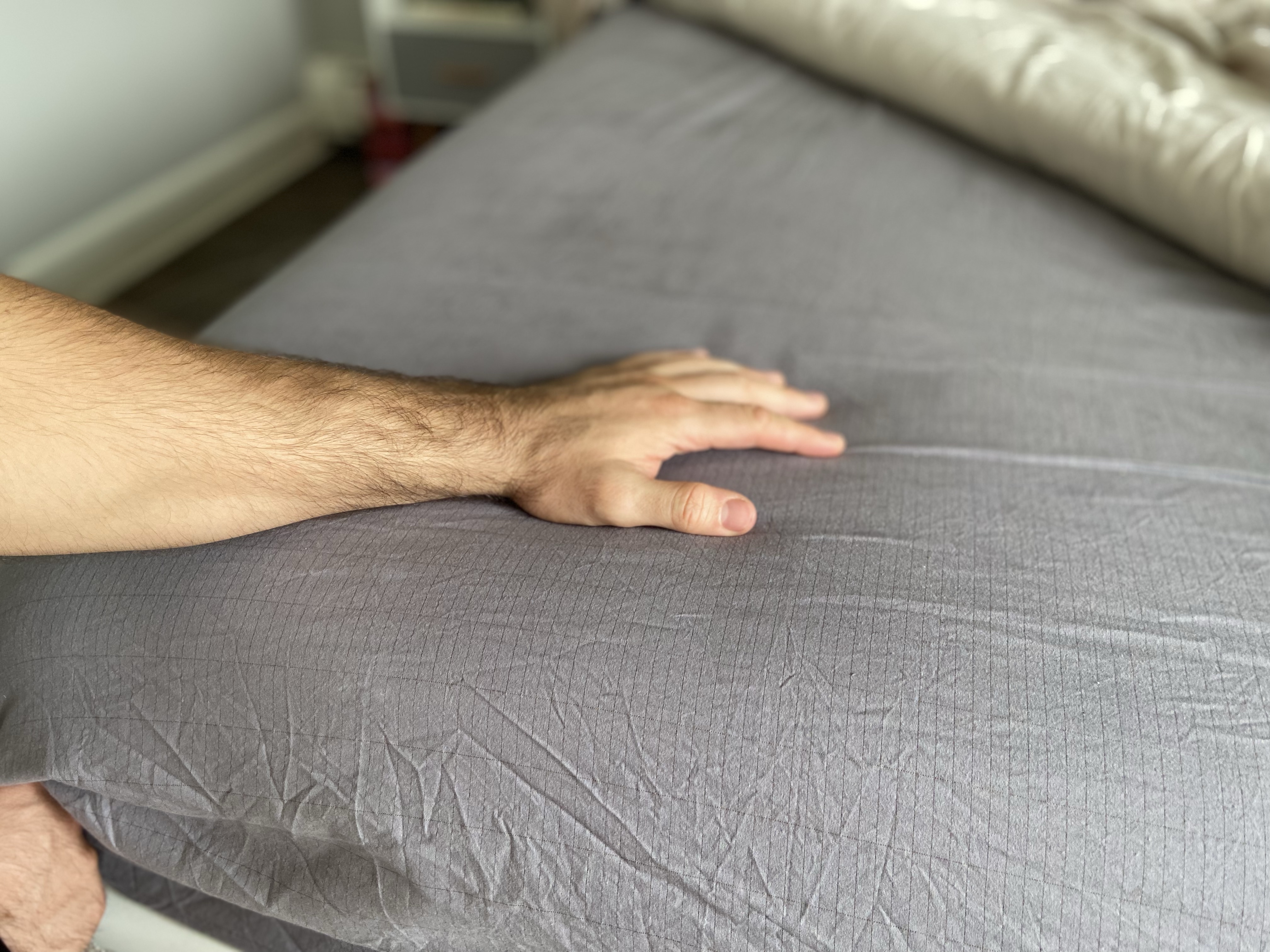
Step 3: Place the Sheet on Your Bed
- Use it just like a normal fitted sheet.
- For best results, bare skin should touch the sheet (e.g., arms, legs, feet). Pajamas or thick blankets can reduce contact.

Step 4: Confirm It Works (Optional But Recommended)
- Use a multimeter to measure your body voltage before and after lying on the sheet.
- If grounded correctly, you’ll see a significant drop in voltage.
- Check the video below to see exactly how to do this
Final Thoughts: Are Grounding Sheets Worth It?
Grounding sheets sit at the intersection of ancient wisdom and modern science. The idea that simply connecting our bodies to the Earth can improve sleep, reduce stress, and support recovery may sound unconventional — but both real-world testing and a growing body of research suggest there’s something here worth paying attention to.
From my own two years of daily use, plus measurable voltage-drop tests and changes in my resting heart rate, I can confidently say: grounding sheets do work electrically, and they may very well work physiologically for many people. The science is still catching up, and not every study is flawless, but we have enough evidence to say these products are more than hype.
That said, grounding sheets aren’t magic. Some people will feel immediate results, others may notice gradual improvements, and a few might not feel much at all. Like most wellness tools, benefits depend on the individual. Factors such as:
- Sleep habits – bedtime routines, room environment, and consistency.
- Stress levels – high-stress individuals may notice bigger shifts.
- Overall health history – chronic pain or inflammation can influence outcomes.
- Mindset and expectations – belief and placebo effects can amplify results.
The value of grounding sheets lies in their simplicity: every night, while you sleep, you can reconnect with the Earth for 6–8 hours effortlessly. For me, that made them worth it.
If you’re curious, my advice is simple: test them for yourself. Use a multimeter if you want proof they’re working, track your own sleep or heart rate, and see how your body responds. At worst, you’ve just bought a set of comfortable sheets. At best, you might uncover a small, natural shift that meaningfully improves your sleep, recovery, and well-being.



Leave a Reply