
- What Are Grounding Sheets & How Do They Work?
- Why People Think They Might Be Dangerous
- When Could Grounding Sheets Be Dangerous?
- Testing the Safety: My Own Results
- What Does The Science Say about Grounding Sheet Dangers?
- Frequently Asked Questions
- Final Verdict: Are Grounding Sheets Dangerous?
Are grounding sheets dangerous?
The sheets plug into your wall outlet while you sleep. So naturally, people ask:
Could this electrocute me?
Anything that plugs into your wall while you sleep sounds like a terrible idea if you don’t understand how it works.
In almost all cases, no—you can’t be electrocuted. But under the wrong conditions, there are real risks you should understand.
Grounding sheets are designed to connect your body to the Earth’s electrical ground while you sleep, but unlike most wellness products, they plug into your home’s grounding system.
That alone raises understandable concerns about:
- Risk of electric shock
- Improper or outdated home wiring
- Lightning and power surge concerns during thunderstorms
- Precautionary concerns for people with implanted medical devices
Online, the answers aren’t consistent.
Some sources claim grounding sheets are completely safe. Others warn about “dirty electricity,” power surges, or hidden electrical risks. For someone trying to make a responsible decision, that contradiction can be confusing and even concerning.
Because grounding sheets interact with your home’s electrical grounding system, this isn’t a topic that should be dismissed lightly or answered with marketing claims alone.
In this article, we’ll take a careful, evidence-based look at whether grounding sheets can be dangerous and under what conditions risks might exist. We’ll examine common safety concerns, review what scientific and medical sources say, and look at real-world testing to understand how grounding sheets actually behave when used correctly.
The goal isn’t to promote or dismiss grounding sheets. It’s to separate realistic risks from common misunderstandings, so you can make an informed decision based on evidence rather than fear.
This article includes hands-on testing, review of peer-reviewed studies, including guidance from major medical organizations such as Cleveland Clinic and WebMD.
What Are Grounding Sheets & How Do They Work?
Grounding sheets, sometimes called earthing sheets, look like ordinary bedding, but they’re woven with conductive materials such as silver, carbon, or stainless-steel threads.
These conductive fibers are what make the sheet “active.” When you connect the sheet to either:


- the ground port of a properly grounded wall outlet, or
- a grounding rod placed directly in the soil outside, your body makes contact with the Earth’s natural electrical field while you sleep.
Here’s the important part:
- Under normal, properly grounded conditions, grounding sheets are not designed to carry live electrical current
- The cord connects only to the grounding system (the same pathway used to safely disperse excess electricity from appliances during a surge).
- What transfers through the sheet are free electrons from the Earth, not current from your home’s wiring.
The goal is to recreate the same effect as walking barefoot on grass, sand, or soil… allowing your body to discharge excess voltage and absorb the Earth’s negative charge.
This is why many users report lower body voltage when tested with a multimeter while lying on a grounded sheet.
Why People Think They Might Be Dangerous
At first glance, grounding sheets raise an obvious red flag: they plug into your wall outlet. For many people, that automatically signals “electricity,” “shock risk,” or even “fire hazard.” Add to that the internet chatter about thunderstorms, pacemakers, or mysterious tingling sensations, and it’s easy to see why confusion spreads.
Let’s break down the main reasons people think grounding sheets could be dangerous and what the evidence actually shows.
1. Fear of Electric Shock
The biggest concern is that a sheet connected to the wall could carry live electricity. In reality, grounding cords attach only to the ground port of an outlet, not the live or neutral wires. The ground port is a safety mechanism that disperses excess current into the Earth. Studies using body-voltage meters show that instead of adding electricity to the body, grounding sheets reduce body voltage compared to lying ungrounded indoors.
2. Thunderstorms and Power Surges
Some users worry about lightning strikes or surges traveling through their home’s electrical system and into a grounding sheet. However, There is no evidence currently supporting the claim, even if there was a lightning strike that could somehow conduct electricity to your outlet, most grounding cords also include built-in resistors (often 100k ohm) to limit current in the unlikely event of a surge.
3. Faulty Wiring or Outdated Homes
If an outlet isn’t properly grounded, a sheet connected to it won’t function as intended and could, in theory, carry stray currents. This is why both electricians and grounding manufacturers recommend testing your outlets with a simple $10 socket tester before use. In scientific studies on grounding, all participants used verified grounded setups, which significantly reduces the risk.
4. Medical Implants and Heart Concerns
People with pacemakers, defibrillators, or other electronic implants sometimes worry that grounding sheets could interfere with these devices. To date, there is no published evidence of grounding products disrupting medical implants. Still, because grounding changes the body’s electrical state and can influence blood viscosity and cortisol levels, many doctors suggest consulting a healthcare professional before starting if you have implanted devices or serious cardiovascular conditions.
5. Electromagnetic Fields (EMFs)
Another myth is that grounding sheets act like antennas, pulling in EMFs from surrounding electronics. In fact, research shows the opposite: when grounded, a person’s body voltage decreases sharply, because excess charge is discharged into the Earth. A study published in the Journal of Alternative and Complementary Medicine found that grounding significantly reduced electric field exposure in the human body.
In short: most fears stem from misunderstanding how grounding works, or from special cases like storms and faulty wiring. While those risks aren’t zero, they are preventable—and the scientific evidence suggests grounding sheets lower electrical stress on the body rather than increase it.
Can Grounding Sheets Electrocute You?
In normal conditions, no—grounding sheets will not electrocute you.
That’s because grounding sheets do not connect to the “live” electrical current in your home. They only connect to the ground port of an outlet, which is designed to safely carry excess electricity away from you—not into your body.
Why Electrocution Doesn’t Happen (In Proper Setups)
To understand this, it helps to know how your outlet works:
- Live wire → carries electricity to devices
- Neutral wire → carries electricity away from devices
- Ground wire → acts as a safety path for excess electricity

Grounding sheets only connect to the ground wire.
That means:
- They do not supply power
- They do not carry active current
- They simply provide a pathway for excess electrical charge to dissipate into the Earth
This is why, in testing, body voltage typically drops when using a grounding sheet, not increases.
When Could There Be a Risk?
While electrocution is not a concern in properly wired homes, risk can exist if your electrical system is faulty or improperly grounded.
Potential issues include:
- Ungrounded outlets → the sheet won’t work correctly and may not safely dissipate charge
- Faulty or outdated wiring → could allow stray voltage to be present
- Improperly wired outlets → rare, but can create unexpected electrical behavior
This is why many experts recommend testing your outlet with a simple socket tester before use.
Bottom Line
Grounding sheets don’t electrocute people because they don’t carry live electricity.
However, like anything connected to your home’s electrical system, their safety depends on proper wiring and setup.
When used with a properly grounded outlet and a quality grounding cord, the risk of electrocution is extremely low.
What Happens If Your Outlet Is NOT Grounded?
If your outlet isn’t properly grounded, a grounding sheet won’t work the way it’s supposed to and in some cases, it could introduce minor electrical issues.
First: What “Not Grounded” Actually Means
In a properly wired outlet, the ground port is connected to the Earth through your home’s electrical system.
If an outlet is not grounded, that connection doesn’t exist.
This can happen in:
- Older homes
- Outdated electrical systems
- Improperly wired outlets
What Happens When You Use a Grounding Sheet Anyway?
If you plug a grounding sheet into an ungrounded outlet:
- The sheet won’t properly discharge electrical charge
- The grounding effect may be reduced or nonexistent
- In rare cases, stray voltage from your home’s wiring may remain present
In other words, instead of safely directing electrical charge into the Earth, the system has nowhere to send it.
Is This Dangerous?
In most cases, this still doesn’t mean you’ll be electrocuted.
However, it does mean:
- The sheet may not function correctly
- You could experience mild sensations like tingling (from ambient voltage)
- You’re not getting the intended grounding benefit
So while it’s not typically dangerous, it’s not ideal—and not recommended.
How to Check If Your Outlet Is Grounded
The easiest way to know is to use a simple outlet (socket) tester.
These devices:
- Cost around $10
- Plug directly into your outlet
- Instantly show whether it’s properly grounded
Many grounding sheet manufacturers and electricians recommend this as a basic safety step before use.
Better Alternative: Grounding Rod
If you’re unsure about your home’s wiring, some people choose to connect grounding sheets to a grounding rod placed directly in the soil outside.


This bypasses your home’s electrical system entirely and provides a direct path to Earth.
Bottom Line
If your outlet isn’t grounded:
- Your grounding sheet likely won’t work properly
- You may be exposed to minor stray voltage
- It’s not inherently dangerous, but it defeats the purpose
For both safety and effectiveness, always confirm your outlet is properly grounded before using a grounding sheet.
When Could Grounding Sheets Be Dangerous?
While grounding sheets are generally considered low risk when used correctly, it’s still important to understand the specific situations where problems could arise. Like any product that interacts with a home’s electrical grounding system, safety depends on proper setup and basic precautions.
Below are the scenarios most often cited by electricians, manufacturers, and medical sources not to create fear, but to clarify where caution is appropriate.
Improperly Grounded Outlets
If a wall outlet is not actually grounded, a grounding sheet connected to it may not function as intended.


In rare cases, improper grounding could allow stray electrical currents from household wiring to remain present instead of safely dissipating into the Earth. This is why testing outlets with a simple socket tester before use is widely recommended.
Old or Faulty Home Wiring
Homes with outdated electrical systems or damaged wiring may not meet modern grounding standards.
While this is uncommon in newer construction, older homes are more likely to have grounding inconsistencies. In these cases, grounding products should only be used after confirming that the electrical system is properly grounded and up to code.
Grounding Cords Without Built-In Resistors
Most reputable grounding sheets include a built-in resistor (often around 100k ohms) in the grounding cord. This resistor limits current flow in the unlikely event of a fault or surge.
Low-quality products without this safety feature may increase risk, which is why product quality and manufacturer transparency matter.
Medical Implants and Electronic Devices (Precautionary)
There is currently no published evidence showing that grounding sheets interfere with pacemakers, defibrillators, or other implanted medical devices.
However, because grounding can influence the body’s electrical potential and blood properties, many medical professionals recommend consulting a healthcare provider before use if you have implanted electronic devices or serious cardiovascular conditions.
These scenarios are uncommon, but acknowledging them is part of responsible use.
When grounding sheets are used with properly grounded outlets, quality components, and basic electrical awareness, the risk of harm remains low but understanding when caution is appropriate helps users make informed, confident decisions.
Testing the Safety: My Own Results
Most articles about grounding sheets talk in theory.
I wanted to see for myself what actually happens when you use one, so I ran a simple test with a digital multimeter and a grounded outlet.
Check out the photos below and the explanation to see how I tested the sheets.


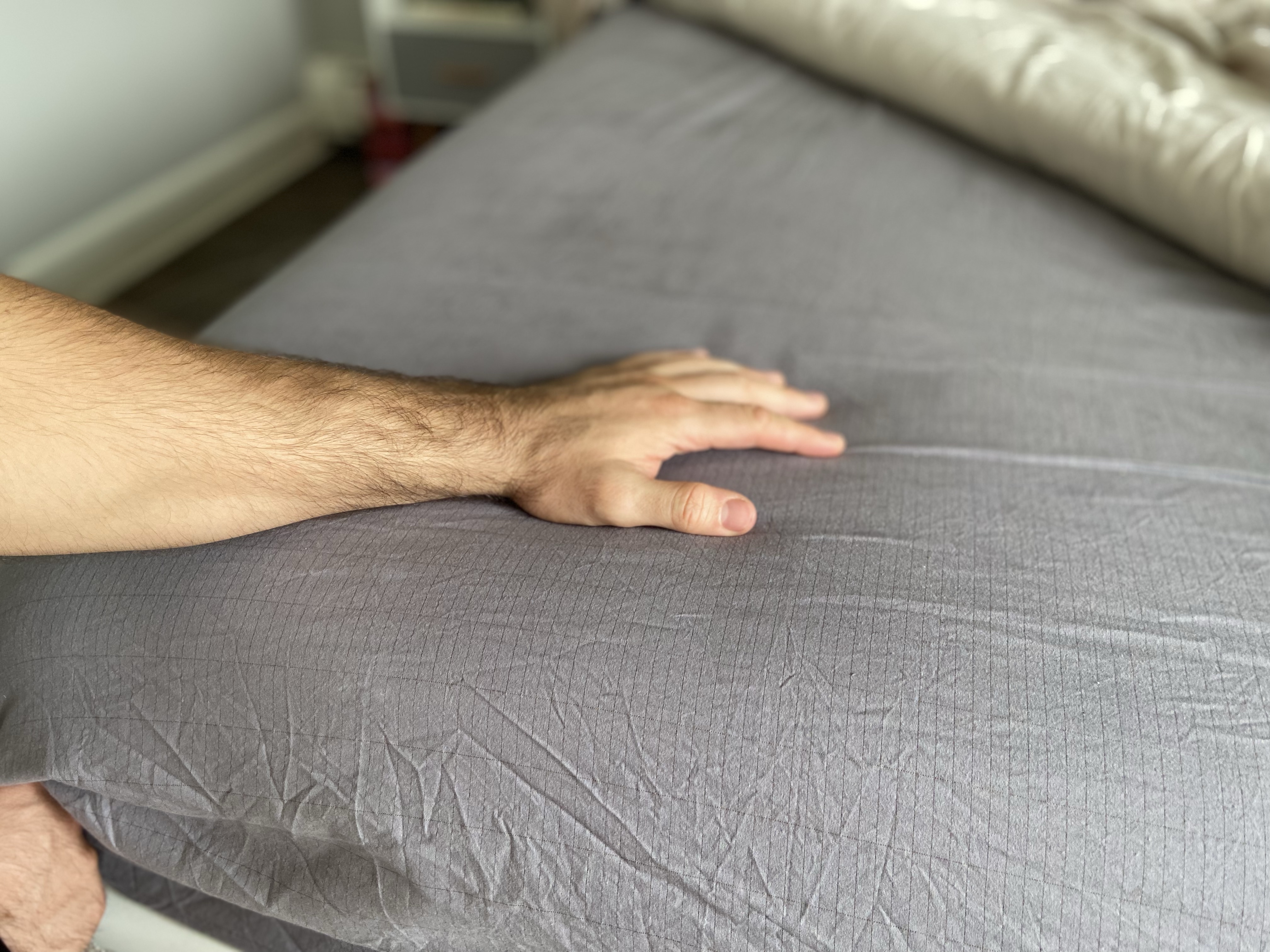
First, I took a multimeter, and plugged it into the ground port of the outlet and held the other probe in my hand to measure my body’s electrical voltage indoors.
Without touching the sheet, my body voltage read 0.124 volts.
Then, I touched the grounding sheet while it was connected to the same ground port. Instantly, the reading dropped to 0.059 volts.
Key Finding: Body voltage dropped by nearly 50% when grounded. That is the grounding effect in action. Instead of carrying more electricity, my body voltage went down when in contact with the sheet.
What the Testing Actually Proves
- This completely contradicts the idea that grounding sheets “send electricity into your body.”
- They provide a pathway for excess charge to discharge into the Earth, which lowers your overall body voltage.
- In other words, they work the same way as standing barefoot on grass or sand, just indoors.
With photos of the test (before and after readings), you can actually see this process. It’s simple, but it proves that grounding sheets, when connected properly, function as a neutralizing tool not as an electrical hazard.
What Does The Science Say about Grounding Sheet Dangers?
Grounding sheets spark strong opinions, but what does the research actually show?
While personal stories and evidence like my own are compelling, peer-reviewed studies give us a clearer picture.
While many grounding studies focus on physiological effects, none identify grounding sheets as an electrical hazard when used properly.
Evidence on Safety
Mainstream medical communications characterize earthing as generally safe when basic precautions (e.g., proper grounding, medical guidance for special populations) are followed. Cleveland Clinic
“Earthing is generally safe, provided you take basic health and safety precautions.”
Alongside Cleveland Clinic, WebMD also frames grounding as low-risk, with the main advice being to check with your doctor if you have specific health conditions. That reinforces the message without overselling.
Grounding is safe for most people, but it’s a good idea to check with your doctor first.” –WebMD
Supporting Evidence: Physiological Effects Observed in Grounding Studies
Most peer-reviewed grounding research focuses on physiological changes observed during grounding, rather than on consumer product safety specifically. However, these studies are still relevant when evaluating whether grounding introduces electrical harm — because they consistently show measurable effects without evidence of adverse electrical exposure.
In controlled research settings, grounding has been associated with changes in hormonal regulation, blood characteristics, and body voltage — all without introducing external electrical current.
Across multiple small clinical and experimental studies, grounding has been associated with the following physiological changes.without evidence of electrical harm:
- Cortisol & sleep: A small 8-week pilot study found that sleeping while grounded reduced night-time cortisol and helped resynchronize diurnal cortisol rhythms, with participants also reporting better sleep and less pain/stress. PubMed
- Blood flow/viscosity: A clinical trial reported that grounding increased red-blood-cell surface charge (zeta potential) and reduced blood viscosity, a cardiovascular risk factor. PubMed
- Body-voltage/EMF exposure: Experimental work measuring people in typical indoor EMF environments showed that being grounded lowers body voltage and currents rather than introducing harmful current. PubMed
“Grounding the human body… reduces night-time levels of cortisol and resynchronizes cortisol hormone secretion.” PubMed
“Grounding increases the surface charge on RBCs and thereby reduces blood viscosity and clumping.” PMC
Frequently Asked Questions
Can grounding sheets cause shocks?
Not if they’re connected to a properly grounded outlet or grounding rod. There is no documented evidence of shock when grounding sheets are used with a properly grounded outlet.
Are grounding sheets safe during thunderstorms?
There is currently no evidence showing grounding sheets increase lightning risk. However, because household grounding systems are complex, some users choose to unplug during severe storms as a precaution.
Can grounding sheets cause heart palpitations?
There’s no clinical evidence linking grounding sheets to heart palpitations. If you have a pacemaker or cardiovascular condition, consult your doctor before use.
Do grounding sheets increase EMF exposure?
No studies show they actually reduce body voltage and lower exposure to ambient EMFs rather than increase it.
Are grounding sheets safe for kids and pets?
Yes, these sheets are safe for children and animals, but always ensure outlets are properly grounded and cords are secure.
Do grounding sheets use electricity?
No. They don’t draw power like an appliance. They only connect to the grounding system of your home or a grounding rod to provide a path to the Earth.
Grounding Sheet: Myth vs Reality
| Myth | Reality |
|---|---|
| “They electrocute you” | No evidence when properly grounded |
| “They pull electricity from walls” | Only connect to ground |
| “They increase EMFs” | Studies show reduction |
| “They attract lightning” | No evidence |
Final Verdict: Are Grounding Sheets Dangerous?
So, are grounding sheets dangerous?
Based on current evidence, grounding sheets are generally considered low risk for most people when used correctly. They are not powered devices, do not supply electricity to the body, and are designed to connect only to the grounding portion of an electrical system or a dedicated grounding rod.
Grounding Sheet Safety Checklist
- Test your outlet with a socket tester
- Confirm proper grounding
- Use sheets with built-in resistor
- Inspect cords for damage

Testing and published research suggest that grounding typically reduces body voltage rather than introducing electrical current. Major medical and health organizations also characterize grounding as a low-risk wellness practice, provided basic precautions are followed.
That said, grounding sheets are not risk-free in every scenario. Potential concerns can arise from improperly grounded outlets, outdated wiring, poor-quality products without built-in resistors, or special medical considerations such as implanted electronic devices. These risks are uncommon but they’re real enough to deserve attention.
The safest approach is a responsible one:
- Verify your outlet is properly grounded
- Use a quality grounding sheet with built-in safety features
- Follow manufacturer instructions
- Consult a healthcare professional if you have underlying medical conditions
Grounding sheets aren’t a miracle solution and they’re not something to fear, either. When approached with basic electrical awareness and common sense, they are best understood as a low-risk wellness tool, not a hidden electrical hazard.



Leave a Reply