
- Grounding Science: Why Your Voltage Drops When You’re Grounded
- Tools You Need To Test Grounding Sheets
- How to Test Grounding Sheets:
- Step by Step Instructions (with Video)
- Troubleshooting for Errors
- What To Do If They Aren’t Working
- Best Grounding Sheets I’ve Tested: GLUYOHEY
- Maintaining Your Grounding Sheets
- Final Thoughts
Why Testing Your Grounding Sheets Matters
Most grounding sheet owners never actually check if their sheets work — they just trust the marketing.
Over time, repeated washing, heavy use, or poor manufacturing can cause the conductive fibers to wear down, leaving you with nothing more than regular fabric.
That means you could be missing out on the very benefits you bought them for — better sleep, reduced inflammation, and faster recovery.
Whether you want to confirm you bought from a reputable brand, check performance after dozens of washes, or see if visible wear has affected conductivity, testing is the only way to know for sure.
I’ve been using grounding sheets for years and have tested multiple brands with a digital multimeter under different conditions — from brand new to heavily worn — and in this guide I’ll show you exactly how to do it yourself, share my real voltage drop results, and give you troubleshooting tips if yours aren’t working.
No electrician or fancy equipment required.

Grounding Science: Why Your Voltage Drops When You’re Grounded
When you’re indoors, your body picks up stray alternating electrical fields (mainly 50/60 Hz from wiring and devices).
Think of your body like a small antenna.
When you connect to earth, whether it’s bare feet outside or a grounding sheet, you equalize your body’s potential with the Earth and give those fields a low-impedance path to ground—so your measured body voltage drops.
What the research shows
- Body voltage falls dramatically when grounded. In a controlled experiment, grounding reduced AC body voltage by an average ~58× compared with ungrounded conditions (participants near common appliances).
- Ambient (mains-induced) voltage is largely neutralized. Reviews and lab studies report that grounding can essentially eliminate the ambient AC potential measured on the body, aligning with what you see on a multimeter when you touch a grounded sheet.
- Proposed mechanism: Reviews in the biomedical literature describe grounding as restoring the body to Earth potential and facilitating electron exchange; regardless of downstream physiological claims, the electrical effect (lower body voltage) is the most consistent, directly measurable outcome.
Plain-English takeaway:
Your multimeter isn’t “detecting magic”—it’s showing less induced AC voltage because grounding ties your body to Earth potential. If your sheet is working and your outlet ground is good, you should see a large before/after drop in AC body voltage.
Tools You Need to Test Grounding Sheets
You only require one device to test your grounding sheets.

A Digital Multimeter
The digital multimeter is key.
It will provide readings that test for voltage/conductivity and hard proof that your grounding sheets are actually working (or not).
However, make sure you use a quality one.
Cheap digital multimeters may not read low voltage which is what we’re testing for here. If you’re looking to purchase one for testing, that offers great quality without spending too much check out the newer versions of these FLUKE multimeters which work great.
Also optional is a grounding tester.
However this device only tests for faulty electrical sockets, not your sheets. Reason I added it is because if your electrical socket doesn’t work your sheets won’t.
Test your socket if you believe it might not be working.
How to Test Grounding Sheets:
- Plug your grounding cord into the grounded port of your outlet.
- Insert the black probe of your multimeter into the “COM” port and the red probe into the “VΩmA” port.
- Set the multimeter to measure AC voltage (“V~” symbol).
- Place the black probe in the outlet’s ground hole and hold the red probe in your hand. Record your body’s voltage.
- Touch the grounding sheet with your bare skin while holding the red probe — if your voltage drops significantly (close to 0V), your sheet is working.
Step by Step Instructions (with Video)
Step 1 – Sheet Setup & Connection
Ensure your grounding cord is plugged into the ground hole/port of the outlet. It’s the middle/circular port underneath the two vertical slots.


Also ensure that the grounding sheets are connected to the cord (photos above). There should be a connection dock on your sheet around the corner section of your sheets.
Step 2 – Multimeter Setup
Grab your digital multimeter and follow the steps for the red and black probes.

- Red Probe: Insert the red probe into the port on the multimeter typically labeled “VΩmA” or similar. This port is used for measuring voltage, resistance, and current (other than high current).
- Black Probe: Insert the black probe into the port usually labeled “COM,” which stands for common. This port is used for the common ground or return path for the measurement.
Turn the multimeter on. There are multiple testing options here but make sure you test for AC voltage. It is represented by the ‘V’ marking with a little squiggly line (representing a sine wave). See photo below for more.

Now you’re ready for testing!
Don’t Make This Mistake: Multimeters can also test DC. It will have a V with straight line with three dashes directly underneath the straight line. Although the two voltage signs looks similar, make sure you are not testing for it. We need to test for AC in order to get the readings/results you desire.
Step 3 – Testing Your Own Voltage
Before testing your sheets, we need to get a reading of your body’s voltage. This is because grounding will have a direct effect on your voltage.
Getting a reading before and after grounding will help us understand how effectively the grounding sheets are reducing your body’s electrical charge.


- Start by plugging one probe of your digital multimeter into the grounding hole of your electrical socket. Ensure it stays within the hole and doesn’t slip out.
- Then grab the other probe and hold the tip of metal point with your hand. Look at your digital multimeter and you should get a voltage reading.
WARNING: Do not place the probe inside the two sockets above the grounding hole. Doing so can lead to electric shock. Only the grounding (circular hole) is safe.
This reading will be different for everyone and changes all the time, don’t worry about the number too much. It could be close to 1V, close to 2V, or in my case 8 volts. Just getting a baseline reading is the important part.
Step 4 – How to Test Your Grounding Sheets for Voltage Drop
Now that we have a reading of your own voltage it’s time to test your sheets.
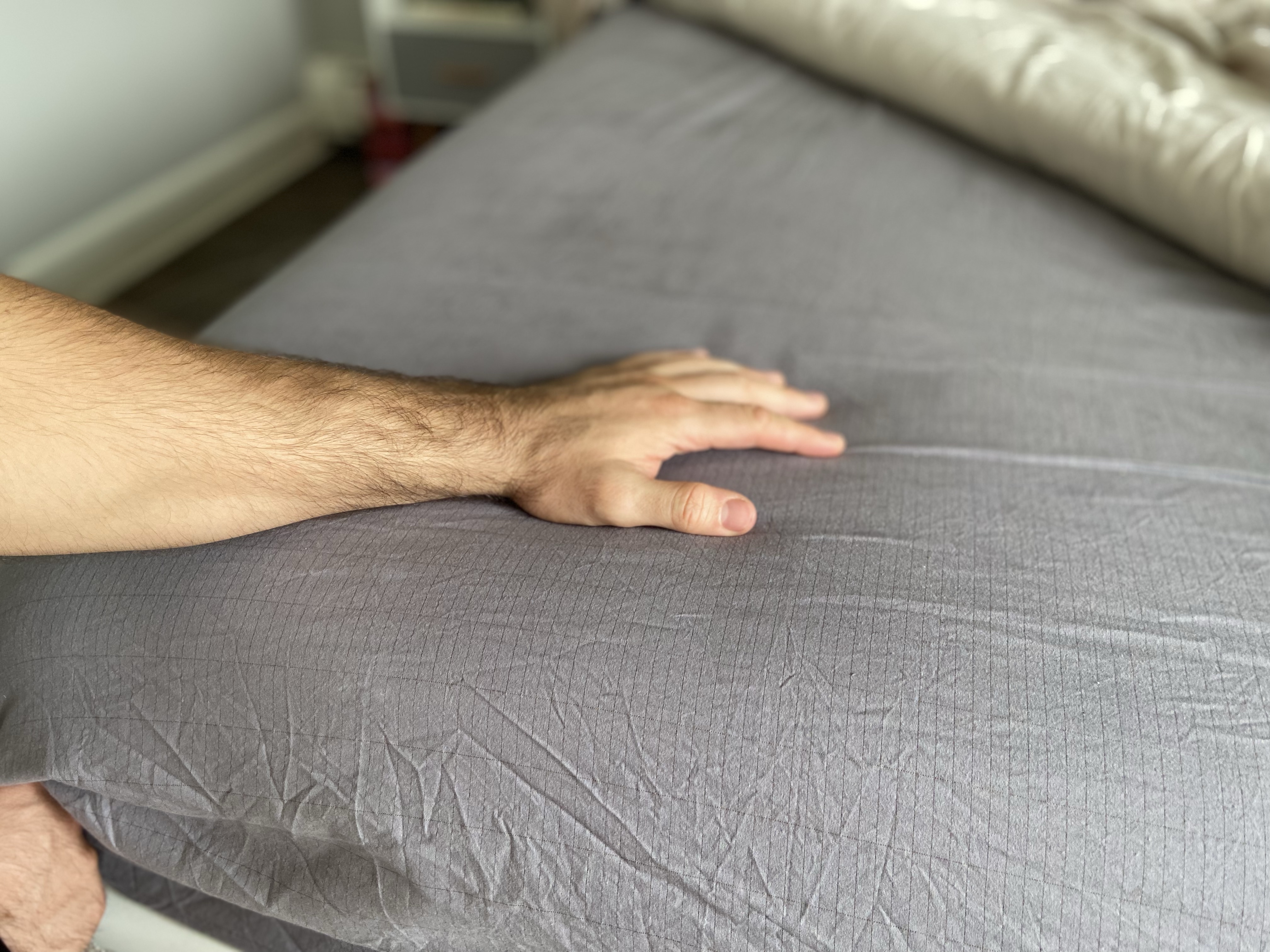
While still holding one end of the probes, touch your grounding sheets with any part of your body (must be your skin).
As you can see in the photos below my voltage without touching the sheets is around 1.5 volts and as soon as I touch the sheets it drops significantly to .76 volts, indicating my sheets are working!


If the voltage drops significantly (often times near 0 volts): Congrats! Your sheets are working and you are getting all the benefits of earthing.
If the voltage doesn’t drop: Your sheets either don’t work, there’s a missing connection somewhere, or your multimeter is low quality and doesn’t read low voltage
Troubleshooting for Errors
If you are not getting a significant voltage drop, check to ensure the following criteria are covered:
Ensure Connection: It’s key that everything is connected. That means your grounding cord to the socket, your sheets to the grounding cord. Any lack of connection will not allow ions to flow from the ground and all the way to your sheets.
Check the Grounding Cord: Ensure the grounding cord is not damaged. Are there any kinks? Is the protective sheath ripped and wires are exposed? Damage can result in poor connectivity.
Probe Connection: Make sure you have correctly placed your multimeter probes. Is one probe secured in the outlet ground hole? Are you holding the other prong directly on your skin? You need both to get a proper reading of yourself and the sheets.
Low Quality Multimeter: It’s possible your multimeter doesn’t read low voltage, meaning you’ll have to purchase a higher quality one to get readings.
Faulty Outlet: It is possible that the home or building you live in has faulty outlets. In order to test this you can use or purchase a grounding tester to check if the outlet is correctly grounded. Purchase one here.
What To Do If They Aren’t Working
The last and least likely scenario is that your grounding sheets aren’t working due to a lack of connection. Here are some reasons why:
- Low Quality Sheets: How much did you spend on your grounding sheets? Did you get them from a cheap Chinese website? The brand could be low quality and/or you were sent counterfeits. Remember, if you want quality sheets you’ll have to pay a more premium price.
- Damaged Sheets: Its possible that the conductivity of the sheets has been damaged. This can be from several factors/reasons. Overwashing can damage your sheets, as well as the solution used to clean the sheets i.e. bleach, industrial vinegar, etc.
If you’ve come to the case that it’s your sheets which are not working, there isn’t much that can be done.
Purchasing a new pair of sheets that are made of high quality fabric and material is the only way to go.
Best Grounding Sheets I’ve Tested: GLUYOHEY
After testing multiple brands, the GLUYOHEY fitted grounding sheet has been one of the most consistent performers.


It’s made from high-quality, conductive fabric that maintained strong voltage drop results even after months of use and dozens of washes. The fit is snug, the fabric is comfortable, and it has thousands of positive reviews backing its quality.
If you want a reliable sheet that actually works and lasts, this is my top pick.
Maintaining Your Grounding Sheets
In order to ensure long term usage of your sheets be sure to:
- Regularly Clean: Follow the manufacturer’s instructions for cleaning, as improper washing can deteriorate the conductive fibers.
- Inspect: Regularly check for visible wear and tear or damage to the connection cord.
Final Thoughts

See how easy it is to test your sheets?
Using a digital multimeter can give you confidence in your investment and the health benefits you seek.
Be sure to regularly test your sheets as time goes on and you wash your sheets.
Although these sheets are washable and will surely last you a long time, regular testing and maintenance can ensure that your grounding products are in top condition, allowing you to maximize the potential benefits of grounding, from improved sleep to reduced inflammation.
With these simple steps, you can take charge of your health and ensure your grounding mats or sheets are functioning as intended.



Leave a Reply